 Skip to content
Yes, at the molecular level. A peer-reviewed study published in Scientific Reports (Nature) in June 2026 found that treatment with a 1940 nm non-ablative fractional laser, the same wavelength delivered by the Frax 1940 handpiece on the Candela Nordlys platform, changed DNA methylation patterns in human skin, and more than 80% of the changes that overlapped with aging moved in the opposite direction of skin aging. It is the first in vivo human study to track epigenetic changes after this treatment over six months.
Researchers studied the epigenetic effects of 1940 nm non-ablative fractional laser (NAFL) treatment. Epigenetic marks, specifically DNA methylation, act like software instructions that tell skin cells which genes to switch on or off. As skin ages, these marks drift in predictable ways, a process scientists call age-associated methylation drift. The study asked a simple question: can a laser treatment push those marks back toward a younger pattern?
Study design, in brief:
The laser treatment remodeled the skin’s epigenetic signature. The team identified 635 differentially methylated regions (DMRs) in treated skin. The changes were not immediate. They appeared after the full treatment course, intensified at 1 and 3 months, and stabilized by 6 months into what the authors describe as a new epigenetic steady state.
Most changes ran opposite to aging. Among the DNA sites that change both with age and with treatment, 83.9% moved in the direction opposite to aging. Sites that gain methylation with age were the most strongly reversed, with a 3.5-fold enrichment. In plain terms, at the majority of responsive locations, the treated skin’s molecular profile shifted away from the aged pattern and toward a younger one.
The affected genes are the ones that matter for skin quality. Changes clustered around pathways for:
Visible results matched the molecular ones. Quantitative VISIA imaging showed that brown spot counts on the treated side fell by a median of 38% at one month and 21% at three months, significantly more than on the untreated side. Texture improved by 15% at one month. Peak visible benefit was seen at the one-month follow-up.
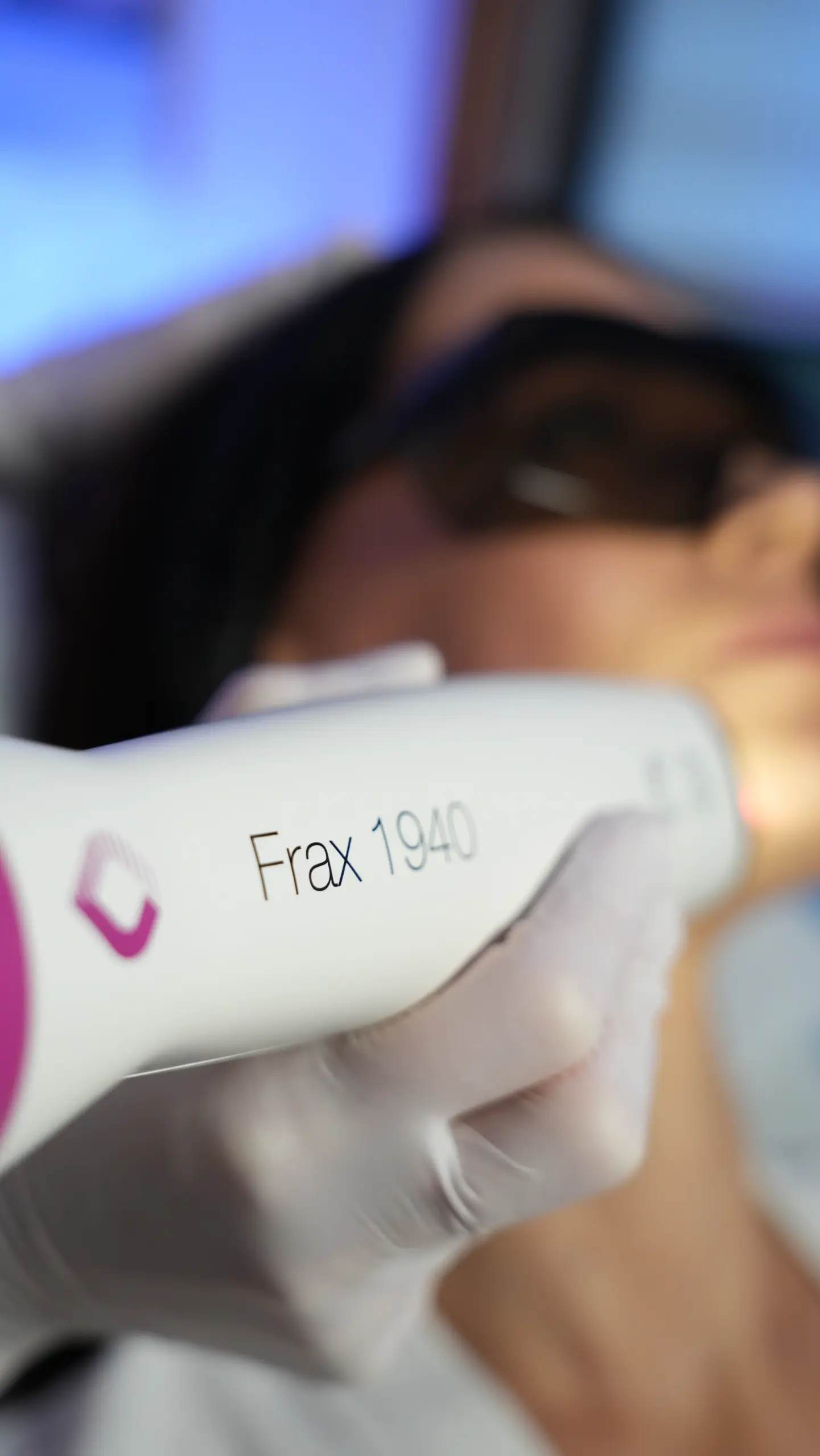
The 1940 nm wavelength is strongly absorbed by water in the skin. The Frax 1940 handpiece on the Candela Nordlys platform delivers the energy in a fractional pattern, creating microscopic columns of controlled thermal injury surrounded by untreated skin. Because the treatment is non-ablative, the surface of the skin is not removed. The controlled injury triggers a wound-healing cascade: collagen remodeling, epidermal renewal, and, as this study now shows, a coordinated epigenetic response in the genes that control repair and regeneration.
At Diamond Advanced Aesthetics in Midtown Manhattan, Frax 1940 treatments are performed on the Candela Nordlys platform, alone or as part of combination protocols such as Light & Bright, which pairs fractional laser treatment with IPL.
Three practical takeaways:
This was a pilot study with a modest number of participants, and the six-month follow-up group was smaller still. The authors are careful with their language, and so are we: they define “rejuvenation” as a partial shift of molecular features toward a younger pattern, not a full reversal of biological age, and more research is needed. The study was funded by the Candela Institute for Excellence, which we disclose because patients deserve to know who paid for the science. Even with those caveats, it is the first direct human evidence that a non-ablative fractional laser changes skin biology at the epigenetic level, not just at the surface.
Diamond Advanced Aesthetics is a medical aesthetics practice at 161 Madison Avenue, Suite 2W, in Midtown Manhattan, New York City. Frax 1940 consultations are provided by our clinical team under the direction of founder Julija DiMante, RN, BSN. If you are considering fractional laser treatment for sun damage, uneven tone, texture, or early signs of aging, a consultation is the right first step: your provider will examine your skin, review your history, and tell you honestly whether Frax 1940, Light & Bright, or another treatment fits your goals. Book a consultation.
Frax 1940 is a non-ablative fractional laser handpiece on the Candela Nordlys platform. It delivers 1940 nm laser energy in a fractional pattern to stimulate collagen remodeling and skin renewal without removing the surface of the skin.
The study, published in Scientific Reports in June 2026, found that three sessions of 1940 nm non-ablative fractional laser treatment changed DNA methylation at 635 regions of the genome in human skin. Of the DNA sites that change both with aging and with treatment, 83.9% shifted in the opposite direction of aging, and brown spots decreased by a median of 38% at one month.
In the study, participants received three sessions spaced 28 days apart, and the epigenetic changes were measured after that course. Your provider will confirm the right number of sessions for your skin during your consultation.
No. Frax 1940 is non-ablative, which means it heats targeted columns of tissue below the surface without removing the top layer of skin. Downtime is typically limited to temporary redness and a rough, sandpaper-like texture as the skin renews.
Adults concerned with sun damage, brown spots, uneven tone, rough texture, fine lines, and early loss of skin firmness are typical candidates. The study enrolled Fitzpatrick skin types II to IV. A consultation is required to confirm candidacy for your skin type and history.
Diamond Advanced Aesthetics offers Frax 1940 treatment on the Candela Nordlys platform at 161 Madison Avenue, Suite 2W, New York, NY 10016. Consultations can be booked online or by calling (212) 933-0434.
Schallen, K.P., Schomacker, K., Banila, C., et al. “Non-ablative fractional laser 1940-nm treatment modulates epigenetic signatures associated with skin aging in a split-face investigation.” Scientific Reports (Nature), published June 30, 2026. https://www.nature.com/articles/s41598-026-56604-4